Architecture
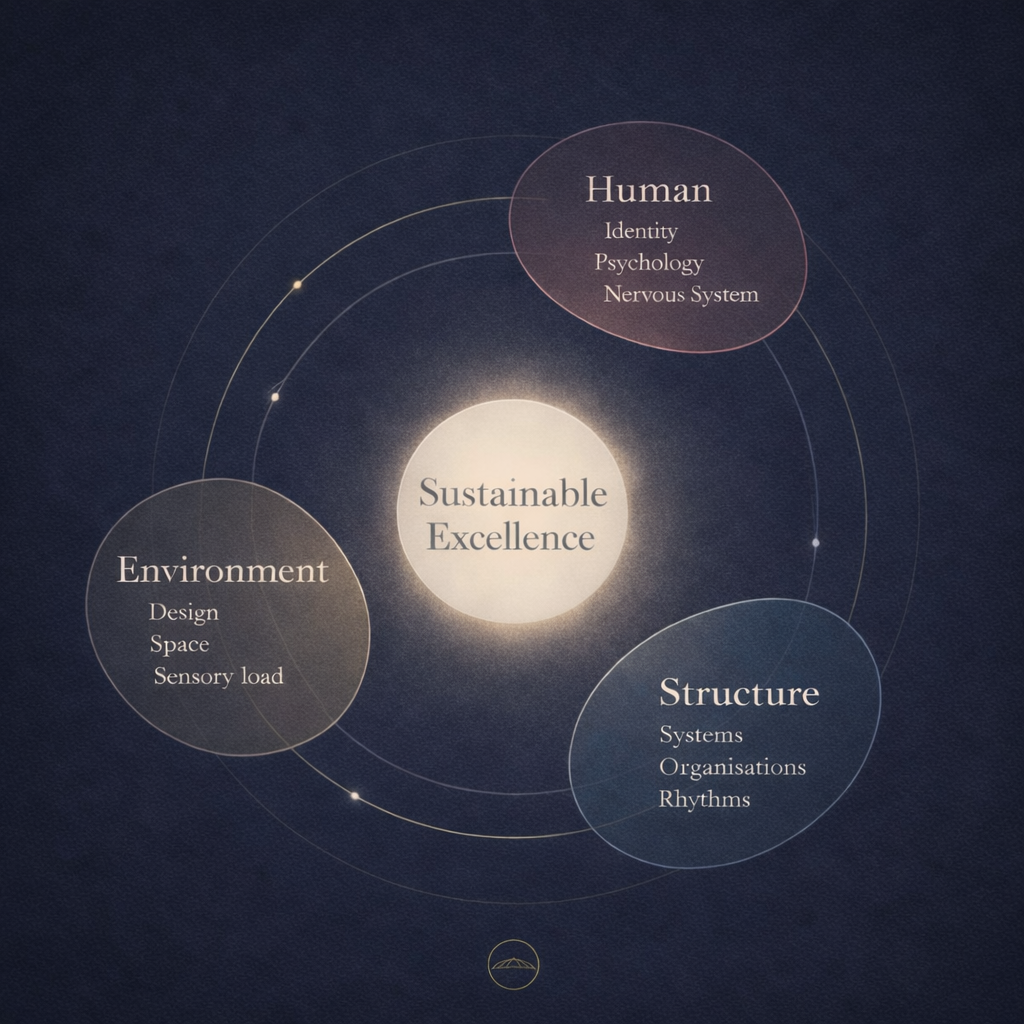
The Architecture of Life is a structural reference architecture for designing human systems under real conditions.
The Exquisite Standard is how that architecture is applied, measured, and certified in the real world.
It is not a programme.
It is not a culture initiative.
It is not a motivational framework.
It is structural infrastructure.
At its core is a simple architectural principle:
Human outcomes are downstream of structural conditions.
Architecture precedes behaviour.
When conditions do not hold, systems rely on effort to maintain what they create.
When coherence and conductivity are deliberately designed, what is created is sustained.
The User Manual
The User Manual: How Humans Really Work sets out the foundational model of human functioning under load.
It explains the structural conditions required for sustainable regulation, recovery, wellbeing and performance.
The User Manual is available as an open intellectual foundation.
Licensing
The Architecture of Life is licensed for operational use within organisations. Licensing grants internal rights to embed the architecture as a structural reference layer for:
System design
Governance
Operational review
Strategy
Decision-making
Certification
The architecture expresses itself through The Exquisite Standard.
This certification forms the return loop of the system, recognising environments where human, environmental, and structural conditions are deliberately designed to support sustainable excellence.
The Exquisite Standard may be applied to environments such as:
-
homes
residential developments
neighbourhoods
cities
urban planning
public infrastructure
civic architecture
transport systems
-
Hospitals
Clinics
Care homes
Assisted living environments
Rehabilitation centres
Mental health environments
Therapy environments
Preventative health centres
-
Schools
Universities
Learning institutes
Alternative education environments
-
Organisations
Companies
Offices
Studios
Professional environments
-
Consumer brands
Luxury brands
Product companies
Experience-led brands
-
Hotels
Resorts
Retreats
Spas
Wellness destinations
-
Members clubs
Cultural institutions
Creative venues
Public spaces
-
Charities
Foundations
Non-profits
Social enterprises
Community organisations
-
political institutions
government bodies
judicial systems
regulatory institutions
civic administrations
public policy environments
democratic institutions
-
Digital platforms
Technology ecosystems
Online communities
Virtual workplaces
Digital products
AI systems and decision environments
Certification is granted only where a system holds under real conditions.
Assessment determines whether those conditions are met.